- Arusha Tanzania
- +255 779 277 811
- info@clotildasafaris.com
- Blogs
- +255 779 277 811
- info@clotildasafaris.com
7 Days Lemosho Route
Price Per Perrsonal
USD $1957
7 Days Kilimanjaro Climb via Lemosho Route – Scenic & Successful
The Lemosho Route is widely regarded as one of the most beautiful and effective ways to summit Mount Kilimanjaro. With its gradual ascent, stunning landscapes, and fewer crowds, this 7-day trek offers a high summit success rate and a truly memorable adventure.
Ideal for both beginners and experienced trekkers, this route traverses a variety of climate zones, from lush rainforest to alpine desert to the snow-capped summit of Uhuru Peak (5,895m) — the highest point in Africa.

Best for
Adventure Lovers
Honeymooners
Mountaineers
Group Safari
Highlight
PAX
Any group size
Accommodation
Camop
Start/End
Arusha/Moshi
Day by day Itinerary
Day 1: Lemosho Gate (2,250m) to Mti Mkubwa Camp (2,650m)
Trekking Time:
3–4 hours
Distance:
6 km
Habitat:
Rainforest
Elevation Gain:
+400 meters
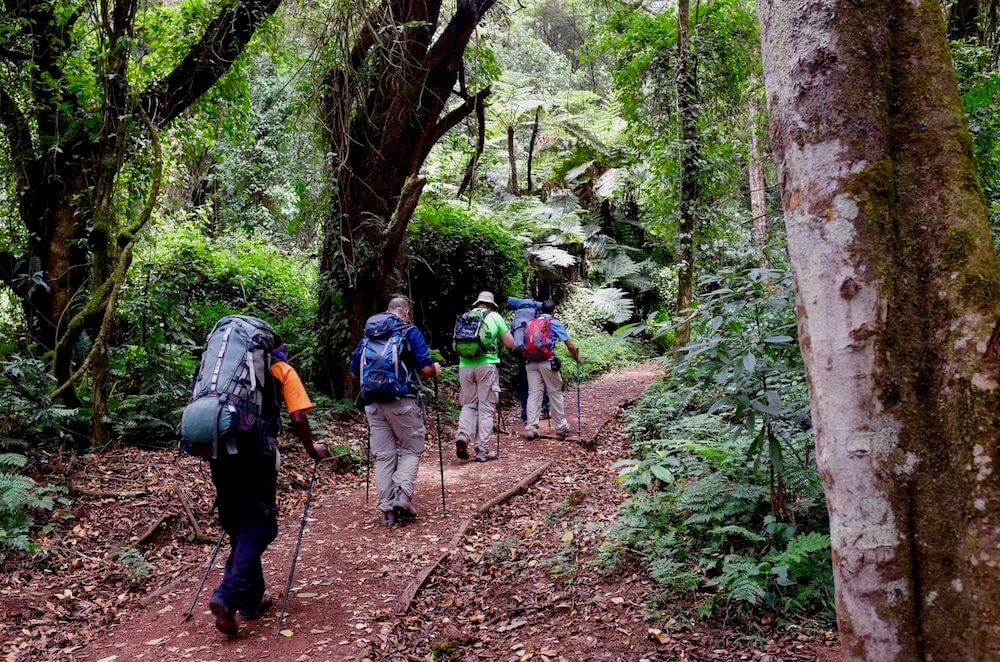
Your Kilimanjaro climb begins at the Lemosho Gate, located on the western side of Mount Kilimanjaro. After registration and a safety briefing, you’ll hike through dense rainforest rich in biodiversity. Expect sightings of black-and-white colobus monkeys, blue monkeys, and vibrant forest birds. The trail is lush and humid, with moss-draped trees and soft, earthy paths.
Day 2: Mti Mkubwa to Shira Camp 2 (3,850m) via Shira 1

Trekking Time:
7–8 hours
Distance:
16 km
Habitat:
Moorland
Elevation Gain:
+1,200 meters
Leaving the forest behind, you’ll enter the moorland zone, where vegetation becomes sparser, and the landscape opens up with sweeping views. The trail climbs steadily to the Shira Plateau, formed by volcanic activity. You’ll pass Shira 1 Camp and continue to Shira Camp 2, located near a stunning ridge overlooking the valley.
Day 3: Shira Camp 2 to Barranco Camp (3,976m) via Lava Tower (4,600m)
Trekking Time:
6–7 hours
Distance:
10 km
Habitat:
Alpine desert
Elevation Gain:
+750m, then descend 624m
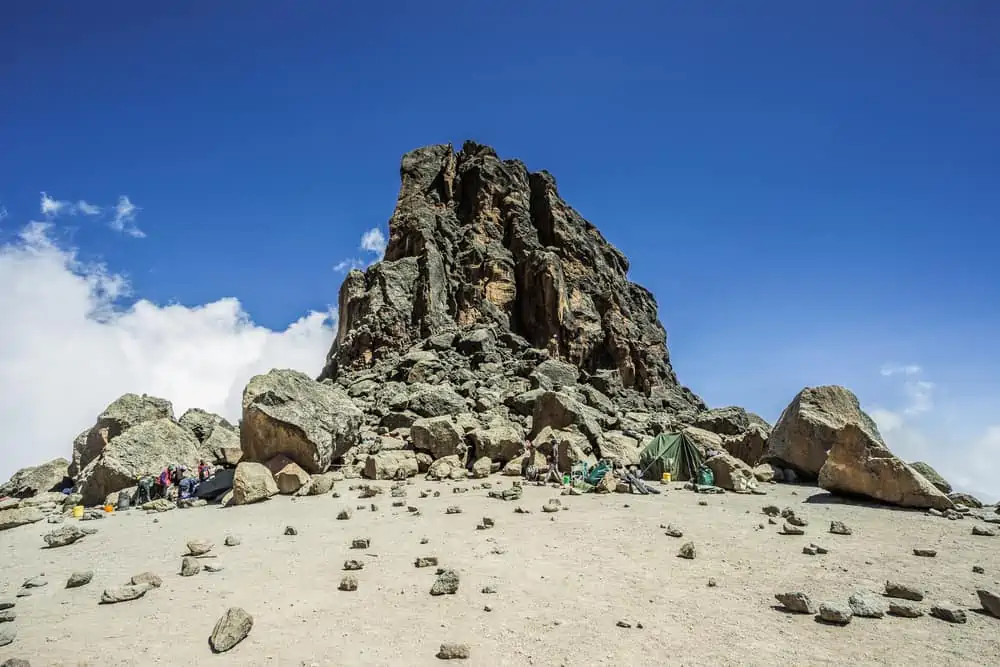
Today is a key acclimatization day. You’ll ascend to Lava Tower, a 300-foot volcanic rock formation at 4,600m, then descend to Barranco Camp. This climb high, sleep low technique helps prepare your body for summit night. Expect striking changes in scenery and a challenging but rewarding trek.
Day 4: Barranco Camp to Karanga Camp (4,035m)
Trekking Time:
4–5 hours
Distance:
6 km
Habitat:
Alpine desert
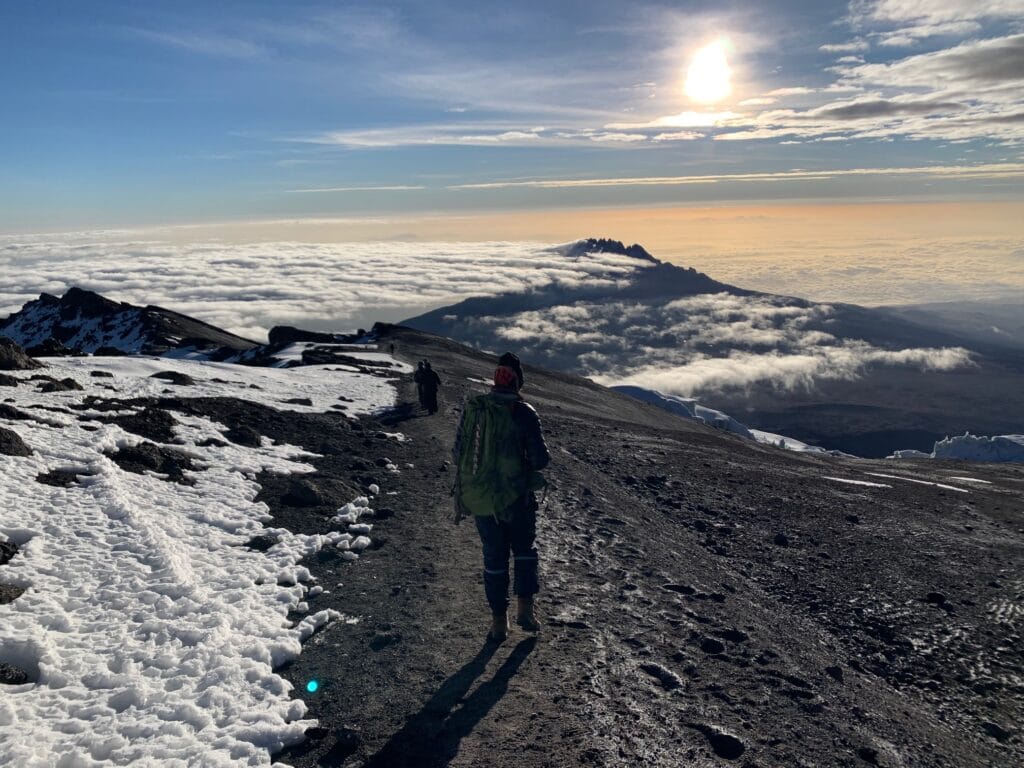
One of the most exciting sections—Barranco Wall, also known as the “Breakfast Wall”. This steep rock face appears intimidating, but it is very manageable and fun with the guidance of experienced guides. After the climb, the trail undulates across ridges and valleys to Karanga Camp, offering beautiful views of the summit.
Day 5: Karanga Camp to Barafu Camp (4,673m)

Trekking Time:
3–4 hours
Distance:
4 km
Habitat:
Alpine desert
A short and steady ascent to Barafu Camp, your base camp before summit night. You’ll arrive early enough to rest, hydrate, and eat in preparation for the final push. Temperatures drop significantly, and the winds pick up at this high altitude, giving you a real sense of the summit environment.
Day 6: Barafu Camp to Uhuru Peak (5,895m), descend to Mweka Camp (3,100m)
Trekking Time:
12–15 hours
Distance:
17 km
Habitat:
Arctic to rainforest
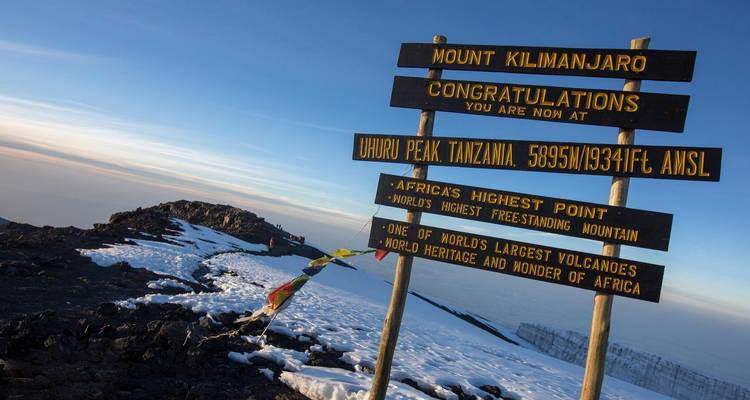
Summit day begins just after midnight. Hike through the dark using headlamps and follow your guide through a zigzag path toward Stella Point (5,756m). After a short rest, continue to Uhuru Peak, the highest point in Africa. Witness a dramatic sunrise over the glacier-capped summit. After photos and celebration, descend via Barafu to Mweka Camp for overnight rest.
Day 7: Mweka Camp to Mweka Gate (1,640m)

Trekking Time:
3–4 hours
Distance:
10 km
Habitat:
Rainforest
Final descent through the rainforest. The path is often slippery and wet, so trekking poles are helpful. Celebrate your achievement at Mweka Gate, where you’ll receive a Kilimanjaro summit certificate. A driver will be waiting to transfer you back to Moshi or Arusha.
Tour Price
1 Person
On Request
2 people
USD $1957
3 people
USD $1927
4 people
USD $ 1899
5 people
USD $1885
6 people
USD $1879
7 people
On Request
Included
- All meals
- FWD transportation with a pop up roof while on Safari.
- Large portions of fresh, healthy, nutritious food:
- Transfer to and from the Airport.
- Accommodation cost on safari.
- Government Taxes.
- Excursions as per itinerary
Excluded
- Tanzania Visa: $50/$100 per person on arrival
- Personal Expenses (e.g. laundry, telephone, beverages, etc.
- Optional Tours.
- International flights
- Yellow fever vaccinations
General tour information
Tanzania visa information
Most travelers require a visa to enter Tanzania.
Visas can be obtained:
- Online via the eVisa system.
- On arrival at major airports (JRO, DAR, ZNZ).
- In advance from a Tanzanian embassy or consulate.
Cost:
- $50 for most nationalities.
- $100 for U.S. citizens.
Passport requirements:
- Valid for at least six months beyond travel dates.
- At least one blank page for entry stamps.
Bookings & Confirmations
- Advance booking is highly recommended, especially for peak seasons (June–October & December–February).
- A deposit is typically required to confirm a reservation.
- Full payment is usually due weeks before departure.
- Upon confirmation, you will receive:
- Detailed itinerary.
- Accommodation information.
- Essential travel details (permits, packing lists, etc.).
Cancellation Policy
- We understand that travel plans may change. Our cancellation policy is as follows:
- More than 60 days before departure: Full refund minus the deposit.
- 30–59 days before departure: 50% refund.
- Less than 30 days before departure: No refund.
- No-show or early departure: No refund.
- We highly recommend purchasing comprehensive travel insurance that covers trip cancellations, medical emergencies, and trekking activities.
Accommodation information
Tanzania offers various accommodation options:Budget:
- Camping & basic lodges.
- Mid-range: Standard lodges & tented camps.
- Luxury: High-end lodges & private tented camps.
Popular safari destinations for accommodations:
- Serengeti,
- Ngorongoro Crater,
- Tarangire, Selous, and Zanzibar.
Most lodges provide:
- Full-board services (meals included).
- Eco-friendly facilities & stunning natural settings.
Early booking is recommended, especially in high-demand areas.
Additional Travel Information
Currency & Payments:
- Tanzanian Shilling (TZS) is the local currency.
- USD is widely accepted, but carrying small cash is advised.
- Credit cards are accepted in most hotels & lodges.
Health & Vaccinations:
- Yellow fever vaccination required if
- traveling from an endemic country.
- Recommended vaccines: Hepatitis A & B, Typhoid, routine immunizations.
- Malaria prevention is advised; carry appropriate medication.
Language & Communication:
- Swahili is the national language, but English is widely spoken.
- Mobile network coverage is available in most tourist areas.
- Wi-Fi is accessible in most lodges and hotels.
Time Zone & Electricity:
- East Africa Time (EAT) – UTC+3.
- Standard voltage: 230V.
- Power plugs: Type D & G – A universal adapter is recommended.
Flights to Tanzania
- International Airport: Kilimanjaro International Airport (JRO) is the closest airport to Moshi, about 45 minutes away.
Alternative Airports:
- Julius Nyerere International Airport (DAR) in Dar es Salaam
- Abeid Amani Karume International Airport (ZNZ) in Zanzibar
From these airports, you can take a domestic flight to JRO with Air Tanzania, Precision Air, or Coastal Aviation.
Important Requirments
Luggate Restrictions
Weight Limit:
Domestic flights in Tanzania have strict baggage limits, typically 15 kg (33 lbs) per person, including carry-on.
Bag Type:
Soft-sided duffel bags are recommended for easy storage on small aircraft and safari vehicles.
Prohibited Items:
Avoid packing plastic bags as they are banned in Tanzania.
Additional Charges: Excess baggage fees may apply if you exceed the airline’s weight limit.
Health Information
Vaccinations:
- Yellow fever vaccination is required if traveling from or transiting through an endemic country.
- Recommended vaccinations: Hepatitis A & B, Typhoid, Tetanus, and Rabies (for those spending extended time in remote areas).
Malaria Prevention:
- Tanzania is a malaria-risk area; consult a doctor for antimalarial medication.
- Use insect repellent with DEET and sleep under a mosquito net when available.
Water & Food Safety:
- Drink only bottled or filtered water.
- Avoid raw or unpeeled fruits and vegetables unless properly washed.
Travel Insurance:
- Highly recommended to cover medical emergencies and evacuation.
Weather in Tanzania
Dry Season (June – October):
- Best time for wildlife viewing with clear skies.
- Cooler temperatures, especially in the early mornings and evenings.
Short Rainy Season (November – December):
- Occasional short rains, but safaris are still possible.
Green Season (January – March):
- Lush landscapes, great for photography and birdwatching.
- Ideal time for calving season in the Serengeti.
Long Rainy Season (April – May):
- Heavy rains, some lodges may close, and roads can be muddy.
What to Pack for a Tanzania Safari
Clothing:
- Lightweight, breathable clothes in neutral colors (khaki, green, beige).
- Long-sleeved shirts and pants for sun and insect protection.
- Warm layers for chilly mornings and evenings.
- Waterproof jacket during the rainy season.
Footwear:
- Comfortable hiking or safari boots.
- Sandals for lodge stays.
Accessories:
- Hat, sunglasses, and high SPF sunscreen.
- Binoculars for wildlife viewing.
- Camera with extra batteries and memory cards.
Personal Essentials:
- Personal medications and a small first aid kit.
- Reusable water bottle.
- Small backpack for day trips.
“This was the most unforgettable experience of my life! I captured stunning and rare wildlife photos, with incredible sightings that left me in awe. The expert guidance from our guide helped me improve my photography skills, and my memory cards were completely full! Beyond the safari, I loved visiting a local Maasai village, where I had the chance to photograph the vibrant culture, daily life, and the hardworking women in the fields. Every moment felt authentic and deeply inspiring. I can’t wait to return to Tanzania and explore even more breathtaking locations!”
Jane P.
Plan your Tanzania adventure
Looking for a Custom Safari Adventure?
From the moment you begin planning your adventure with Clotilda Safaris, we’re here to guide you through every detail, creating a personalized itinerary tailored to your preferences and level of exclusivity. While our remote team manages bookings, transfers, and activity arrangements, our dedicated ground team is available 24/7 to assist with any needs, ensuring a seamless experience from start to finish.